US Secretary of State Marco Rubio on Saturday invited Indian Prime Minister Narendra Modi to visit Washington, reiterating the importance of a relationship that is under increasing tension, a week after the United States held a warm summit with China.
After joining US President Donald Trump in Beijing a week ago, Rubio – who visited the two Asian powers for the first time – went to New Delhi and met Modi for more than an hour, and invited the Prime Minister to visit the White House soon.
Rubio “stressed the strategic importance of the US-India partnership, rooted in our deep shared democratic and trade opportunities and the strong personal relationships” between Modi and Trump, State Department spokesman Tommy Piggott said, brushing aside last year’s friction between the world’s two largest democracies.
In a post on X, Modi said he was “happy” to receive Rubio.
“We discussed the continued progress of the Indo-US Comprehensive Global Strategic Partnership and issues related to regional and global peace and security,” he wrote.
Modi stressed that India and the United States “will continue to work closely for the global good.”
Trump has shaken basic assumptions about US foreign policy, including a commitment to building a stronger relationship with India, which was barely mentioned in the National Security Strategy his administration launched last year.
During his visit to China, Trump praised the reception he received from President Xi Jinping, despite limited concrete announcements.
Trump also spoke of the United States and China being a “pair of the two” – a formula that has fallen out of favor in recent years, as US allies fear being left out of Washington’s dealings with a rising China.
Starting with the nuns
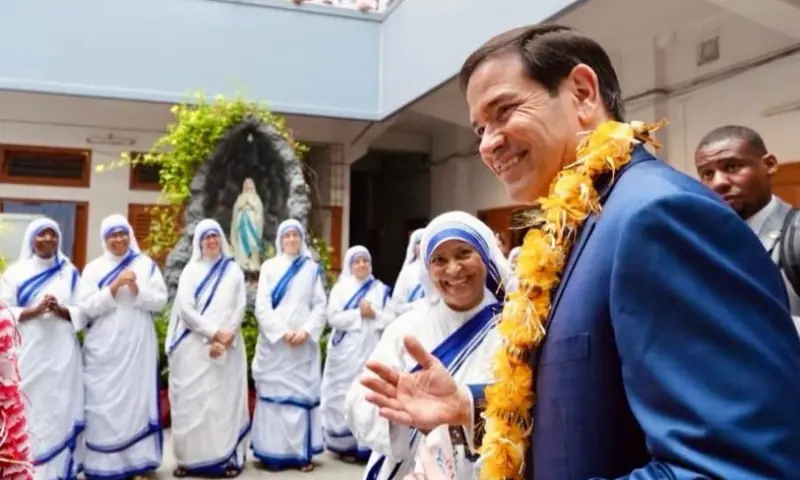
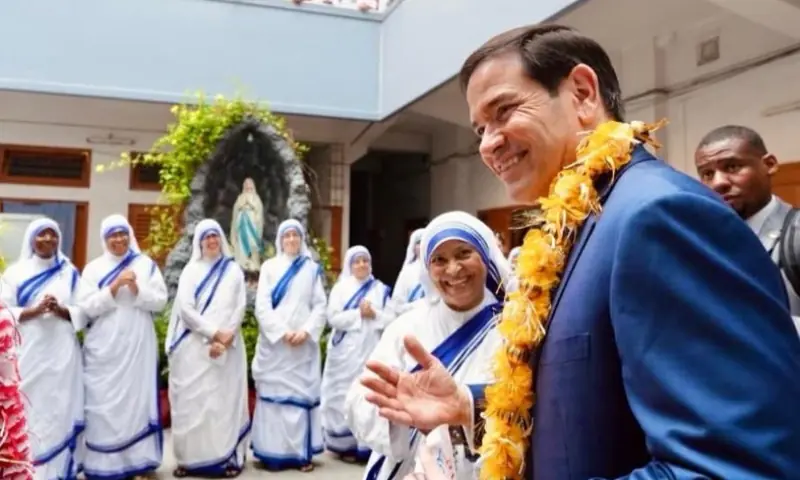
Rubio, a devout Catholic, began his four-day, four-city tour by visiting the headquarters of the Mother Teresa Charitable Society in the eastern city of Kolkata and praying at her grave.
Rubio, joined by his wife, Janet, wearing a yellow wreath over his suit, smiled at a group of nuns, all wearing the deceased’s signature white and blue sari.
“Rubio talked about helping the homeless, the terminally ill, and those afflicted with leprosy,” Sister Mary Juan of the Missionaries of Charity Society told reporters after his hour-and-a-half visit.
“He was happy to pray and we were also happy to have him,” she said.
Later, Sergio Gore, the US ambassador to India who is also a Catholic, posted that the visit showed that the relationship between the two countries was built “not only on strong policies, but also on shared values.”
</figure>
While Trump rarely raises human rights, some elements of his base have expressed concerns about the treatment of Christians under the Hindu nationalist Modi, making Rubio’s choice for the first stop highly symbolic.
Human rights groups say there has been a rise in attacks on minority Christians across India, including vandalism of churches, since Modi came to power in 2014.
</figure>
The government rejects these allegations as exaggerated and politically motivated.
Before his departure on Tuesday, Rubio will also participate in a meeting of foreign ministers of the so-called Quad – Australia, India, Japan and the United States – four democracies seen as a counterweight to China’s presence in the Indian Ocean.
China has long been skeptical of the Quad, describing it as an attempt to encircle it, and has rebuked India in the past for participating in it.
Before the trip, Rubio called India a “great ally and great partner” and said the United States would look for ways to sell it more oil.
India’s fast-growing economy relies on energy imports and, like many countries, has been shaken by the US-Israeli attack on Iran, which responded by strangling the strategic Strait of Hormuz, sending global oil prices soaring.
India has historical ties with Iran, but it also enjoys a growing relationship with Israel, which Modi visited just days before the war.
But the conflict has also seen the US re-emerge as a key partner for Pakistan, a traditional adversary of India, which has positioned itself as a mediator and whose powerful army chief traveled to Tehran on Friday.
</figure>
The United States was a partner of Pakistan in the Cold War, but it increasingly distanced itself from it as it prioritized relations with India, seeing the world’s largest democracy as a natural partner in a world order marked by the rise of China.
Trump moved away from long-held assumptions and expressed sympathy for Pakistan, which lavished praise on him for his diplomacy in its brief conflict with India last year, and welcomed a cryptocurrency company owned by the US president’s family.
Modi angered Trump when he did not take credit for ending the conflict, in which India struck Pakistan following the Pahalgam attack in Indian-occupied Kashmir.
Trump imposed punitive tariffs on India shortly thereafter, at higher rates than he imposed on China, but they were eased under a trade agreement.