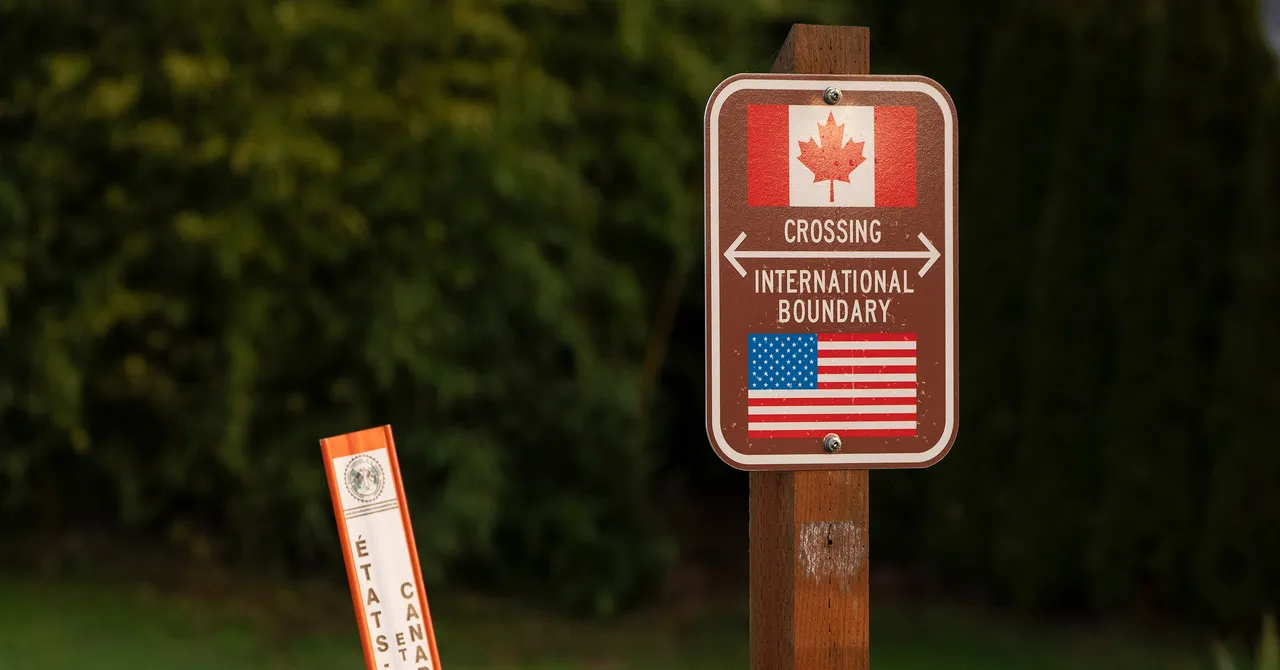
A new DHS call for participants frames the experiment, known as ACE-CASPER, as a multi-day exercise that “simulates a national emergency response scenario,” in which drones and ground vehicles transmit live feeds to a binational command and control center as they cross the border. The document notes that the vehicle’s autonomy is secondary to its primary goal: demonstrating “flexible and continuous 5G communications.”
DHS and DRDC did not immediately respond to a request for comment.
The tests, scheduled for November, will be the first joint US-Canada cross-border technology trial along their shared border in nearly a decade. From 2011 to 2017, the two governments organized five cross-border exercises under a program called CAUSE, to test whether emergency responders on both sides of the line could share radio, video and data equipment with their counterparts across the border.
Although couched in the areas of public safety, search and rescue, and emergency response, DHS describes many of the capabilities the trial will exercise in military terms, asking vendors to demonstrate, for example, the ability of autonomous vehicles to gather “real-time battlefield intelligence.” The desired air systems are described as “Command and Control: Intelligence, Surveillance and Reconnaissance” – or C2ISR – platforms, an acronym borrowed from the US Department of Defense, and are linked to improving “kill chains”.
DHS announced the drone trials through government procurement channels by the Department’s Research and Development Branch, the Science and Technology (SandT) Directorate, in partnership with its northern counterpart in Canada Defense Research and Development.
The directorate is located at the technical center of the US federal government’s counter-drone program following a restructuring by executive order signed by President Donald Trump in 2025. Last week, SandT’s National Urban Security Technology Laboratory launched a counter-drone procurement tool, designed to guide police and emergency response agencies in the Washington, D.C., area – and the 11 US states hosting FIFA World Cup matches this summer.
The same package of executive orders also prioritized the purchase of U.S.-made drones and reserved government contract opportunities for domestic manufacturers, marking the opening of a major market for the U.S. drone industry, which was further expanded by the recent FCC designation banning new foreign-made drones from U.S. wireless networks.
Any group of companies able to respond to the November trial call will include multiple vendors with ties to the president’s eldest children.
Among these companies is Powerus Corporation, a Florida-based drone manufacturer, which recently merged with the golf course company backed by Eric Trump and Donald Trump Jr. Anduril Industries, which Trump Jr. invested in last year, produces a range of battlefield surveillance-oriented drones for the Pentagon, while landing the Department of Homeland Security’s largest border security contract: a $1.1 billion agreement to deploy artificial intelligence-powered surveillance towers along the southern border.
“Powerus welcomes any effort by DHS to enhance border security through advanced autonomous systems,” Brett Velicovich, Powerus co-founder, told WIRED. “Protecting America’s borders is exactly the mission for which our technology was built, and we are encouraged to see the government moving urgently in this direction.”
Unusual Machines, a manufacturer of drone components in Orlando, Florida, where Trump Jr. previously served as an adviser and received stock worth about $4.4 million today, does not sell directly to the government, a company spokesperson told WIRED, but sells to suppliers who do.
Xtend, the Israeli drone maker now backed by Eric Trump, also opened a headquarters in Tampa, Florida, in the summer of 2025, and announced a multimillion-dollar contract from the Pentagon’s Office of Special Operations last fall. Xtend declined WIRED’s request for comment.