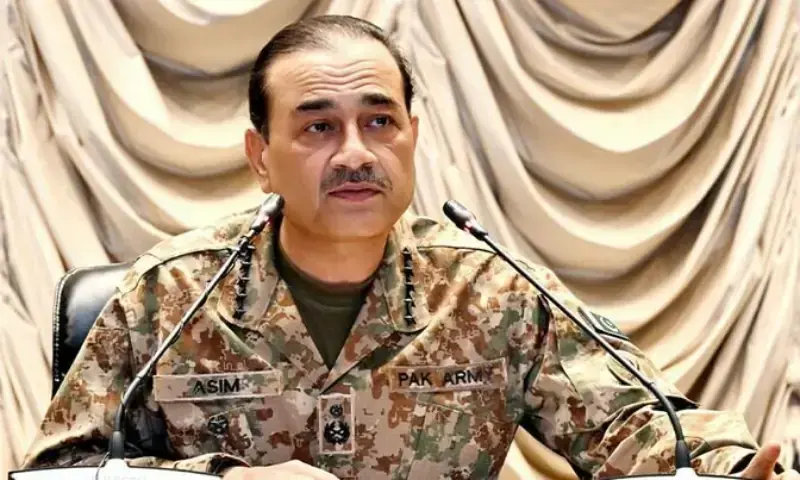
The Army High Command on Tuesday emphasized that peace and stability in the region are intrinsically linked to collective self-restraint, responsibility and respect for sovereignty, said a statement issued by the Army Media Affairs Wing after the 275th Corps Commanders’ Conference.
Inter-Services Public Relations (ISPR) said Defense Forces Commander and Chief of Army Staff Field Marshal Asim Munir chaired the meeting at the General Headquarters in Rawalpindi.
The military leadership’s observation comes against the backdrop of the conflict between the United States and Iran. The matter began with US-Israeli strikes on Iran in late February, and its scope later expanded into a regional crisis, including disrupting traffic in shipping lanes and launching attacks on Gulf states.
The conflict has been temporarily halted for the time being, following a fragile ceasefire that is still being tested.
The Corps Commanders’ Conference, while deliberating on the broader regional security environment, “noted that emerging geopolitical developments carry significant implications for regional stability,” the ISPR statement said.
The senior officers stressed the importance of restraint and “avoiding escalation” and “acknowledged Pakistan’s continued responsible role in calling for stability and supporting efforts to prevent further deterioration of the situation.”
According to ISPR, the conference “affirmed that peace and stability in the region are intrinsically linked to collective self-restraint, responsibility and respect for sovereignty.”
Munir, who chaired the meeting, expressed satisfaction with the high standards of operational readiness, professionalism and combat readiness of the Pakistan Armed Forces.
He commended the “commanders and formations for their unwavering commitment, vigilance and success” in counter-terrorism operations across the country.
The process of usurping the right
The meeting comprehensively reviewed the internal and external security environment and “resolved to maintain the current pace of operations to decisively dismantle terrorist networks, disable their supporting infrastructure, and deprive them of any operational space within Pakistan,” the ISPR statement said.
Meeting participants also noted the “continued deterioration of terrorists and their supporting infrastructure” through Operation Ghazb al-Haqq.
It was a process of usurping the right Fired By the Pakistani armed forces on the night of February 26, after cross-border shooting by the Afghan Taliban. Military action also targets terrorist hideouts.
Islamabad has repeatedly accused Kabul Space saving To the banned Taliban movement. UN monitoring reports over the past two years have noted the presence of the Pakistani Taliban in eastern Afghanistan, although the Taliban have denied providing support.
According to ISPR, the Corps Commanders’ Conference referred to the Afghan Taliban regime’s “irrational and perverse policy of providing safe havens to its soldiers.” Kharijites And other terrorist organizations, with complete disregard [the] interests [the] “The Afghan people are increasingly counterproductive and completely exposed.”
ISPR said the forum also took into account the Afghan Taliban’s “propaganda campaign” to “falsely portray Pakistan as targeting civilians inside Afghanistan.”
Senior army officers described “such misleading narratives as part of a coordinated disinformation strategy pursued by the regime to divert attention from its internal failures and games.” [the] Victim card.”
“The forum categorically rejected these frivolous allegations and reiterated that Pakistan’s defense measures remain focused, precise and directed only against infiltrators, terrorist hideouts and supporting infrastructure,” the ISPR statement said.
Dem right
ISPR added that the meeting participants also congratulated the nation and the armed forces on the first anniversary of Marka ul-Haq, recognizing it as a “defining moment that reflects national unity, collective resolve, and unwavering commitment to protect Pakistan’s sovereignty at all costs.”
Marka Al-Haq refers to the period of conflict between Pakistan and India last year. It began with the Pahalgam attack in occupied Kashmir on April 22, and ended with the end of Pakistan’s Operation Punniyanum Marsus and ceasefire on May 10.
According to the ISPR, the conference stressed that “the national commemoration of Marka Haq is a clear message to… [the] The arrogant Indian political mindset that the Pakistani nation stands united, resilient and fully prepared.
“It signifies the unwavering harmony between the people, the government and the Armed Forces of Pakistan, who stand together as ‘Banyanum Marsus’ against all internal and external challenges.”
Moreover, the senior army officers “strongly condemned the ongoing atrocities, extrajudicial killings and demographic changes” in Indian-occupied Kashmir and reaffirmed Pakistan’s unwavering diplomatic, political and moral support for the just struggle of the Kashmiri people, the statement said.
He further stated that the forum highly paid tribute to “the martyrs of the armed forces, law enforcement agencies and innocent civilians who sacrificed their lives in defense of the motherland.”
“Paying deep tribute to their unparalleled sacrifices, the forum reaffirmed that the enduring legacy of the martyrs continues to serve as the bedrock of Pakistan’s national security, unity and resilience,” the statement said.
At the conclusion of the meeting, Mounir instructed commanders to maintain the highest levels of vigilance, operational readiness, and adaptability in the face of evolving threats.
He stressed the need to “continue to focus on professional excellence, integrated response mechanisms and proactive measures to confront traditional and non-traditional challenges,” the ISPR statement said.